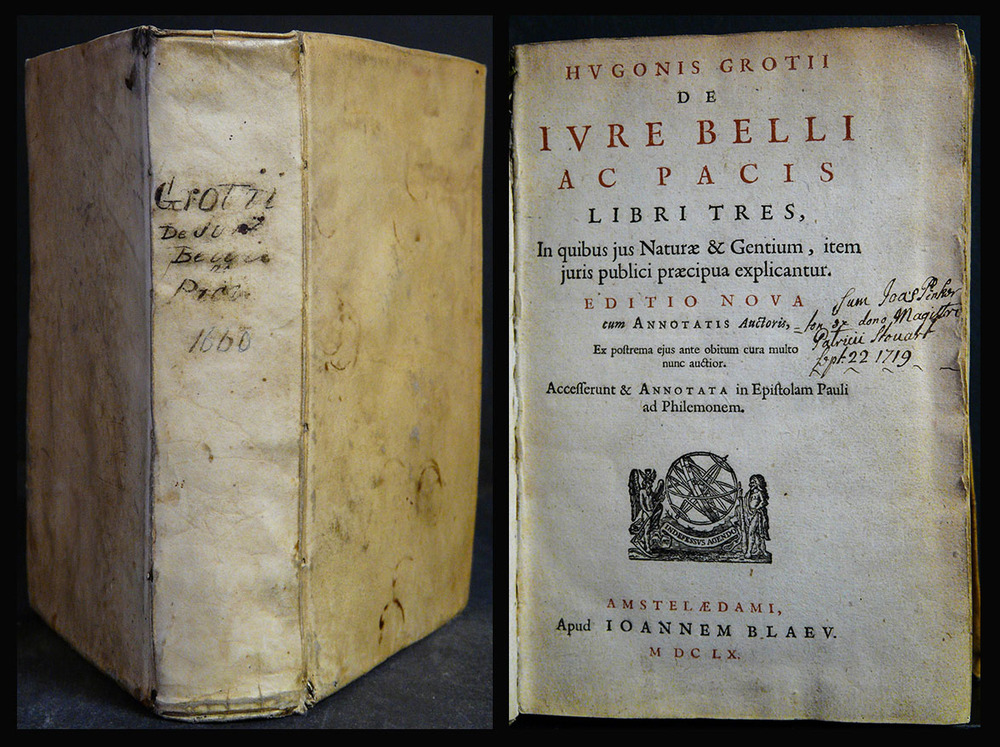
Grotius, Hugo: De Iure Belli ac Pacis Libri Tres, in quibus jus Naturae & Gentium, item juris publici praecipua explicantur. Editio Nova (1660)
€850,00
Hugo GROTIUS (1583-1645)
DE IURE BELLI AC PACIS LIBRI TRES, IN QUIBUS JUS NATURAE
&GENTIUM, ITEM JURIS PUBLICI PRAECIPUA EXPLICANTUR.
EDITIO NOVA CUM ANNOTATIS AUCTORIS, EX POSTREMA
EIUS ANTE OBITUM CURA MULTO NUNC AUCTIOR.
ACCESSERUNT & ANNOTATA IN EPISTOLAM PAULI AD
PHILEMONEM.
Amsterdam: Apud Ioannem Blaeu, 1660
Description : [in 8vo]. – pp. [24] , 618, [46]
First published in 1625, while Grotius was living in exile in Paris (after his ingenious escape from Holland in a box full of books), De Jure Belli et Pacis (On the Law of War and Peace) made its author famous throughout Europe, and ultimately came to be regarded as the cornerstone of modern political philosophy and jurisprudence. His treatise is widely considered the first systematic attempt to establish the principles of “natural law” and social contract as the basis for government, rather than revelations of religion or the self imposed edicts of emperors; as such it anticipated the ideas of the great political theorists of the 18th century, and laid the foundations of modern international law. Living in the times of the Eighty Years’ War between Spain and the Netherlands and the Thirty Years’ War between Catholic and Protestant European nations, it is not surprising that Grotius was deeply concerned with matters of conflicts between nations and systems of beliefs. His most lasting work, was a monumental effort to restrain such conflicts on the basis of a broad legal and rational consensus. Grotius wrote: ‘Fully convinced…that there is a common law among nations, which is valid alike for war and in times of peace, I have had many and weighty reasons for undertaking to write upon the subject. Throughout the Christian world I observed a lack of restraint in relation to war, such as even barbarous races should be ashamed of; I observed that men rush to arms for slight causes, or no cause at all, and that when arms have once been taken up there is no longer any respect for law, divine or human; it is as if, in accordance with a general decree, frenzy had openly been let loose for the committing of all crimes.’
Contemporary binding in full stiff vellum, handwritten title on spine, title in red and black, woodcut printer’s device bearing motto indefessus agendo, old handwritten annotation of ownership and donation, good interiors with usual moderate spotting and browning due to age and kind of paper.
In the overall a very good copy of this fundamental xvi century work on international law in times of peace and war, highly esteemed by bibliophiles and scholars.
Cfr.: PMM, Printing and the Mind of Man, Monaco (1983), ref. 125 (1625 Ed.). SAPORI, Antichi testi giuridici, 1465 ; VREELAND, HAMILTON. Hugo Grotius, Oxford University Press, (1917); Knight, W.S.M. The Life and Works of Hugo Grotius. London: Sweet & Maxwell, Ltd., (1925) ; BLL Berkeley Law Library, Glasgow Collection, ref. KZ2093.A3


